Solo project — Year 2
Arena of the Damned
Arena of the Damned is a one-arena boss fight against the undead as they claw their way back to standing. Armed with only a dash and a rifle, you have to out-position a boss that refuses to stay down — a solo-developed Unreal Engine 5.6 prototype built in 8 weeks.
- Team size
- 1 (solo)
- Duration
- 8 weeks
- Engine
- Unreal Engine 5.6
- Platform
- Windows
- Role
- Game design, 3C's design, combat design
- Project type
- Student project — Year 2, Block A
Overview
A single arena boss fight where you face the undead as they try to rise up again. Built solo over 8 weeks in Unreal Engine 5.6, the project covers a full boss encounter loop end to end — player controls, boss attack design, and the tuning that decides whether a fight feels fair or just frustrating.
Project goals
- Main goal — designing a boss fight and learning the fundamentals of a boss character
- Mastery through repetition — the player should feel a clear sense of progression with each retry, and be able to spot counters to the boss's attack patterns
- Tension — the player should feel constantly alert and focused on the boss; the boss should feel dangerous and unpredictable
- Pressure — players should feel urgency to think quickly and be forced into split-second decisions
Achievements
- Developing a boss that has multiple attack patterns
- Designing a simple twin-stick player character with a dash
- Rapid prototyping to test if the intended player experiences are being achieved
- Adjusting the scope of the project to still fit my learning goal of creating a boss fight
- Turning fun interactions spotted in playtests into actual features
- Using basic debugging tools to help find errors
Challenges
- Initial concept was a melee-focused boss fight, but I struggled for weeks making the melee weapon work in engine
- Visual clarity — getting the bullets to be readable but hard to dodge was quite a challenge
- I had a hard time translating my gameplay sketches into Unreal features myself; being very inexperienced in Unreal, I was intimidated by building things in engine
Contributions
Player Character
The player character was originally intentioned to be designed for a defensive close combat fight, using just a shield to block and repel attacks. Playtesting showed players preferred direct control over their attacks rather than just repelling the boss's, so I iterated on it and made a more offensive design that revolves more around positioning with the hunting rifle.
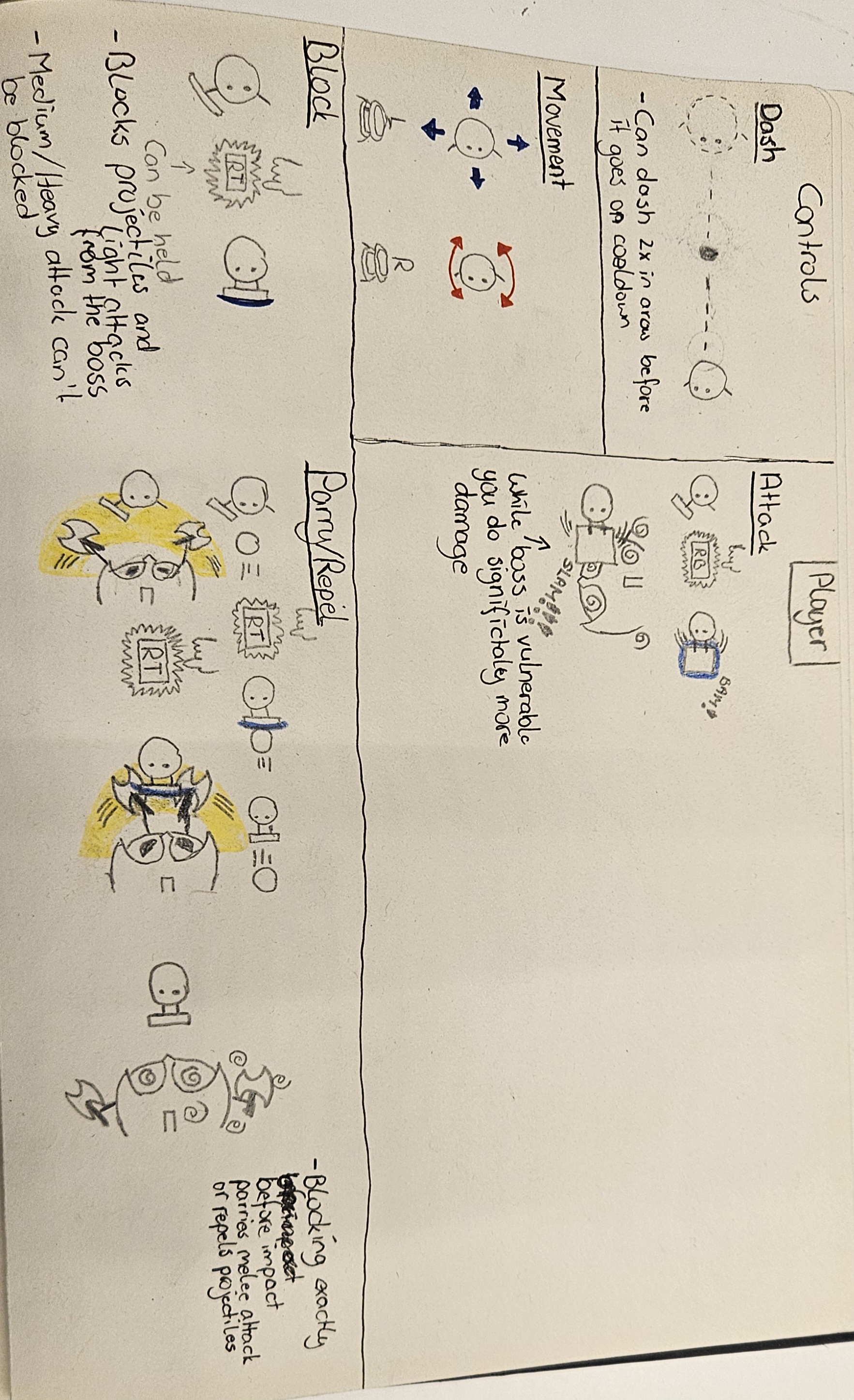
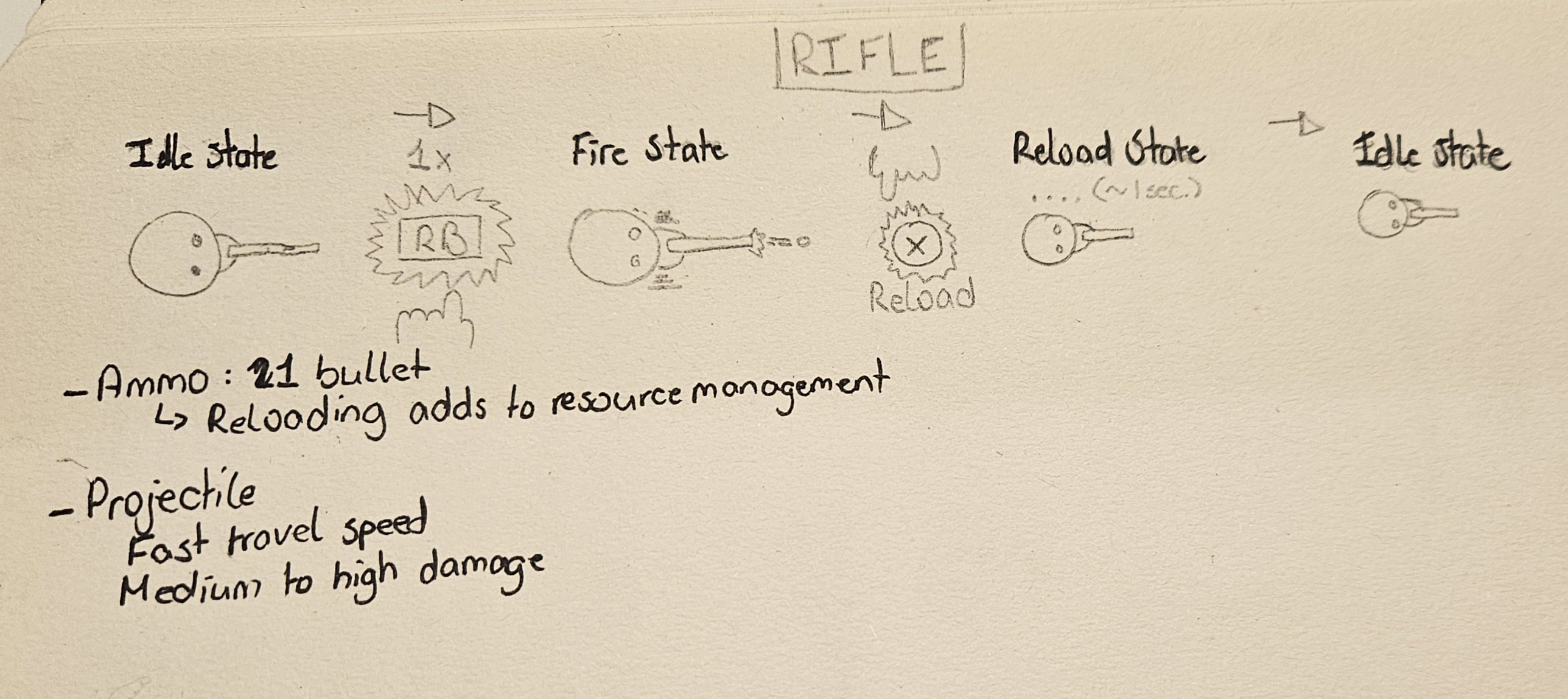
Through further testing, 2 more observations surfaced. It was difficult for players to aim the rifle well while also having to pay attention to their positioning. The rifle was changed to rapid fire so the skill focus was less on aiming and more on positioning. Another observation I saw was that due to a bug players could dash and shoot at the same time. This turned out to be one of the highlights of most testers so I made it a proper part of the game.
Boss Character
The boss was initially aimed to do melee attacks, but I had a hard time implementing what I wanted in Unreal. Most of my time went into iterating on the boss's dash attack, since I couldn't get the trajectory right — and instead of learning from the problem, I kept beating myself up for not getting it right.
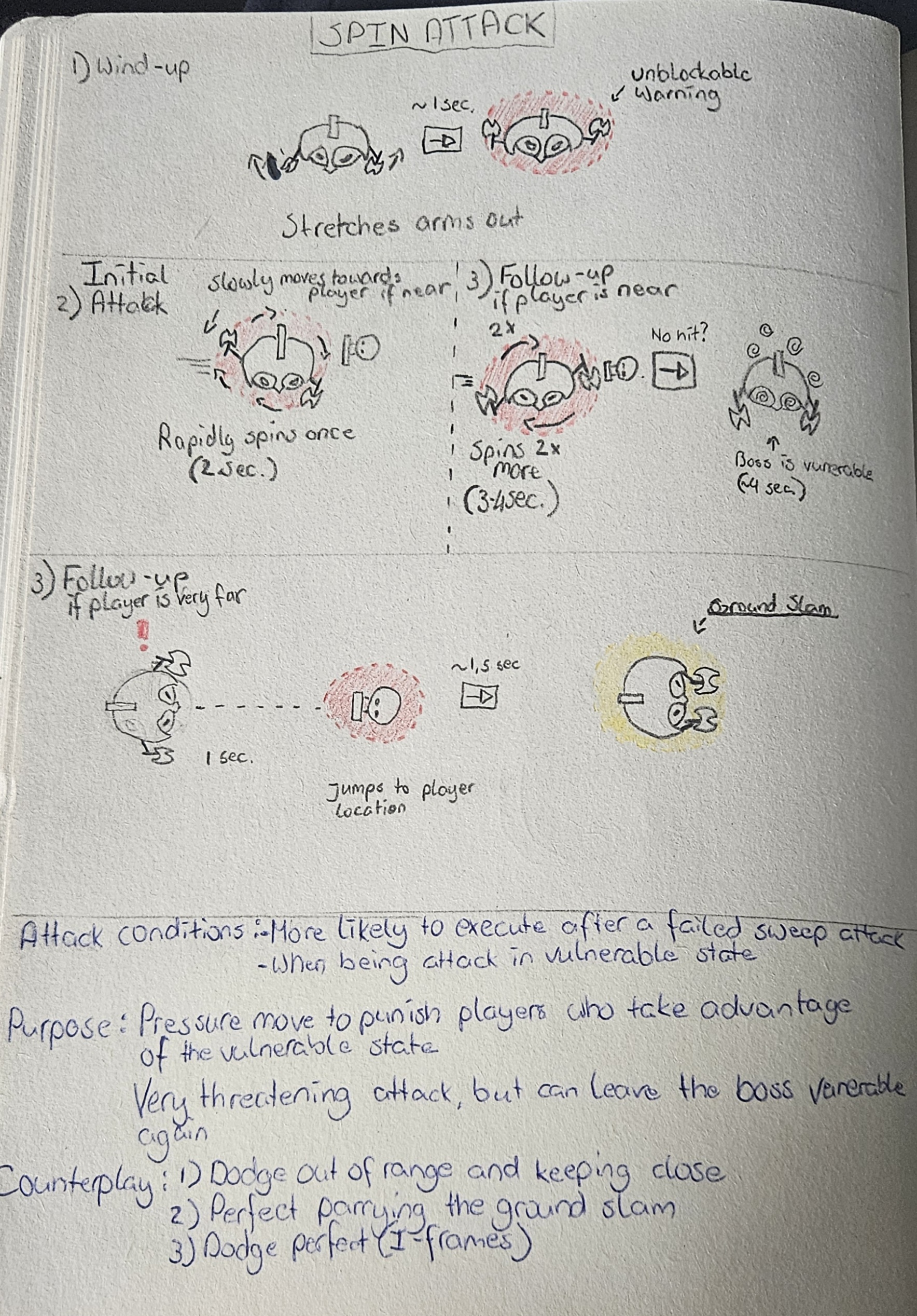
Implementing the ranged attacks went much smoother. I ended up creating 2 more attacks, a projectile ring attack and an exploding projectile attack that also had a variant that fired 3 in a row — sketch to engine was a clean process, and playtesting let me fine-tune both to better fit my design goals.
Learnings
- Build first, refine later — a prototype revealed more design flaws and possibility spaces than documentation did
- Playtest with a diverse audience — it can reveal insights and problems that only affect a certain group, reduces bias, and helps make the game more accessible to a wider audience
- Looking back at my reflections from last year, it felt more like I was admitting failures than trying to understand and find ways to improve. That was mostly because we were expected to work in a specific manner — now that I've experimented with new tools, I feel like I'm growing as a student and designer
- I shouldn't be afraid to ask for help when I'm stuck — I should do it more often, especially now that I'm trying to find ways to improve myself